
Among other the differentiating functionalities introduced by LTE-advanced are:
- Carrier Aggregation (CA)
- Enhanced Inter cell Interference Coordination (eICIC)
- Coordinated Multipoint (CoMP)
Consequently it requires a more sophisticated backhauling infrastructure capable of delivering:
- Synch with phase and time of day
- Higher transport capacity from cell to core
- Higher transport capacity between cells
- More stringent latency requirements for X2 transport
As per today the vast majority of backhauling networks are built using simple Carrier Ethernet transport in the backhauling “cell to pop” network.
FIGURE 1: CET based backhauling
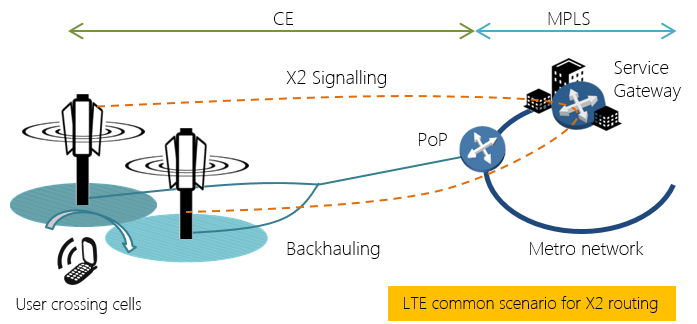
Enabling Layer 3 networking in the backhaul would shorten the X2 routing among neighbouring cells at the cell level, reduce the network load of unnecessary traffic to the core network, improve capacity utilization in the backhaul and reduce to a minimum, the X2 latency, improving overall the radio access performance.
FIGURE 2: Layer3 based backhauling
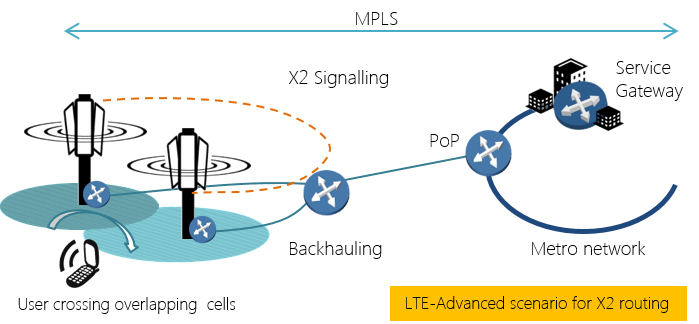
With the implementation of MPLS, operators would also be in the position of creating more articulated backhauling architecture including rings or mesh/partial mesh, offering a higher level of resiliency and network availability that would prove fundamental in the deployment of future 5G highly reliable network applications.
The use of Layer 3 microwave supporting IP/MPLS functionalities within the backhaul network as showed in the above picture provides several advantages:
- Best TCO solution over a dual box solution
- Single equipment at each site incorporating all protocol and technologies needed
- Capability to decide when and how to enable the L3 services
- Best power consumption solution vs a dual box solution
- No need of integration tests at each site
- Better MTBF values, and no single point of failure
The use of Layer3 microwave vs a dual box solution can bring an estimated total TCO savings of over 40% in a 10000 links microwave network, with a conservative approach of addressing 50% of the sites.